South African Cooperatives Embrace coops.africa
A Gateway to Regional Markets and the Future CDEx Capital Market
The adoption of the coops.africa platform by South African cooperatives marks a significant step toward the creation of a truly integrated regional cooperative economy. As cooperative enterprises across Southern Africa seek new opportunities for growth, market access, investment, and collaboration, digital infrastructure is becoming increasingly important in connecting cooperators across borders and preparing them to participate in the next generation of cooperative finance.
This momentum has received a major boost from the support of the South African National Apex Cooperative (SANACO), which has formally endorsed and adopted the coops.africa platform as a strategic tool for the modernization of the cooperative sector. SANACO has confirmed its intention to integrate the platform into its membership management, reporting, training, market access, and regional collaboration activities, while also supporting the onboarding and verification of cooperatives throughout South Africa.
The significance of this development extends beyond digital transformation. As cooperatives onboard onto coops.africa, they begin building the governance, compliance, reporting, and operational standards necessary for participation in broader cooperative investment ecosystems, including the forthcoming Co-op Debenture Exchange (CDEx). Through the platform, cooperatives can establish digital profiles, maintain records, demonstrate governance compliance, engage in trade, and connect with investors and development partners. These capabilities will be increasingly important as cooperative enterprises seek access to regional capital markets and investment opportunities.
The relationship between coops.africa and CDEx represents a new model for cooperative development in Africa. coops.africa provides the digital infrastructure that enables cooperatives to collaborate, trade, share information, and build value chains across borders. CDEx will provide the capital market infrastructure that enables those same cooperatives to access investment capital to expand production, processing, logistics, housing, manufacturing, financial services, and other cooperative activities. Together, these platforms create a complete ecosystem where cooperatives can not only do business together but also mobilize capital for growth.
South Africa represents one of the most significant opportunities within this vision. As one of Africa's largest and most diversified economies, the country possesses thousands of cooperative enterprises operating across agriculture, housing, financial services, worker ownership, manufacturing, retail, transport, and community development sectors. The successful onboarding and preparation of even a fraction of these cooperatives could create substantial opportunities for capital formation and investment participation on CDEx once the exchange becomes operational.
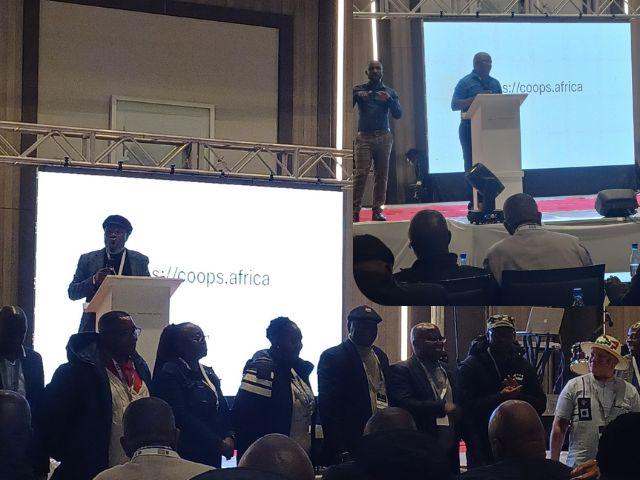
Importantly, the movement toward regional integration was highlighted during the International Cooperatives Day celebrations, where Coops.africa supported the event through its digital platform capabilities while working alongside the Department of Small Business Development (DSBD) and cooperative leadership structures. The platform's ability to broadcast, connect, and engage cooperative stakeholders demonstrates the practical role technology can play in strengthening the cooperative movement across national boundaries.
The International Year of Cooperatives has renewed global attention on the role cooperatives can play in building resilient and inclusive economies. Across Africa, policymakers, development institutions, and cooperative leaders increasingly recognize that cooperatives are uniquely positioned to address challenges related to employment creation, food security, housing, financial inclusion, and community wealth creation. However, unlocking their full potential requires modern infrastructure capable of supporting growth at scale.
This is where coops.africa becomes more than a digital platform. It becomes a foundation for regional economic integration. By enabling cooperatives in South Africa, Zimbabwe, and other African countries to connect, trade, collaborate, and share opportunities, the platform helps establish cooperative value chains that extend beyond national borders. Agricultural cooperatives can connect with processing cooperatives. Housing cooperatives can access suppliers. Financial cooperatives can identify investment opportunities. Women's cooperatives can access new markets. Youth cooperatives can participate in regional enterprise networks.
The long-term vision is the emergence of a circular cooperative economy across Southern Africa and eventually the continent. In this model, cooperatives trade with one another through coops.africa, build strategic partnerships across sectors and countries, and access growth capital through CDEx. Capital raised through the exchange supports productive cooperative enterprises, which in turn create jobs, generate income, strengthen communities, and create further opportunities for investment and collaboration.
The endorsement of Coops.africa by SANACO demonstrates that cooperative leaders understand the importance of preparing their members for this future. SANACO has specifically highlighted the platform's role in market linkages, regional engagement, governance alignment, data analytics, compliance, and cooperative development. These are precisely the foundations required for cooperatives to participate effectively in modern capital markets and regional economic networks.
As CDEx moves closer to launch, the growing participation of South African cooperatives on coops.africa sends a strong signal about the future direction of the cooperative movement. The future will be digital. The future will be collaborative. The future will be regional. Most importantly, the future will be owned by cooperators themselves.
Through the combination of coops.africa's collaborative infrastructure, SANACO's leadership, the support of institutions such as the DSBD, and the capital formation opportunities that CDEx will provide, Southern Africa is laying the foundation for a new era of cooperative growth. One in which cooperatives are not isolated local enterprises, but interconnected participants in a regional economy capable of mobilizing capital, creating wealth, and driving inclusive development for generations to come.
Recent Posts
-
From strategy to national impact
15 Jun 2026
-

Building leaders before building capital
15 Jun 2026
-

A journey of persistence, cooperation and belief
15 Jun 2026
-

-

CDEx Partners with DAMREV
14 Jun 2026
-
From Digital Inclusion to Capital Inclusion
14 Jun 2026
-

-